

The roxzone: how to nail your HYROX transitions
The roxzone is where HYROX races quietly leak time. Here is how to move through your transitions fast, calm and clean.
The Roxzone: How to Nail Your HYROX Transitions
Most athletes train the eight runs and the eight stations. Almost nobody trains the bit in between. That bit is the roxzone, and it is where a surprising amount of your finish time quietly disappears.
The roxzone is the central transition area of a HYROX race. After each 1km run you cross it to reach your station, you complete your reps, and then you cross it again on your way back out to the next run. Do the maths and you pass through the roxzone sixteen times in a single race. The clock never stops for any of it.
None of those crossings feel like much on their own. Ten seconds of dithering here, a slow walk to find your lane there, a fumble for your water. But sixteen times over, a sloppy roxzone can cost you two or three minutes. For most age-groupers, that is the difference between two finish-time brackets, earned or lost without touching a single rep.
Here is how to stop leaking that time.
Why the Roxzone Is Free Time
Improving your wall balls takes months of work. Improving your roxzone takes a single race plan and a bit of discipline. That is what makes it the best value in the whole event: the fitness is already in your legs, you just have to stop wasting it.
Think of every transition as having two jobs. The first is to get from A to B without losing momentum. The second is to arrive at your next effort ready to start it well. A good transition does both. A bad one either burns seconds or dumps you into the station flustered and out of rhythm.
Keep Moving, Always
The single biggest roxzone mistake is stopping. You come off the run, the station is right there, and the temptation to take a breather before you start is enormous. Resist it. A dead stop is the hardest thing to restart from, and it teaches your body that transitions are rest. They are not.
- Come off the run and keep walking with purpose straight to your station.
- Never fully stop unless you are physically racking or picking up equipment.
- Treat the walk itself as your recovery. You can breathe hard and move at the same time.
The goal is not to sprint the roxzone. Sprinting it just spikes your heart rate before a station that needs control. The goal is a brisk, deliberate, continuous walk. Purposeful, never frantic, never stationary.
Know Exactly Where You Are Going
You cannot move decisively toward a station you are still looking for. Confusion is slow, and it is completely avoidable.
- Walk the venue before your heat if you can. Learn where each station sits relative to the run exit.
- Memorise the running order so you always know what is next while you are still on the run.
- Pick your lane as you approach rather than drifting in and hunting for a free spot.
By the time your feet hit the roxzone, the decision should already be made. You are not deciding where to go, you are simply going there.
Handle Your Micro-Tasks on the Move
Every small on-course task is a chance to either save or waste time: chalking up, pulling gloves on or off, grabbing a mouthful of water, wiping your hands. Batch them and do them while walking whenever possible.
- Decide in advance which stations you will chalk for (usually the sled pull, farmers carry and wall balls) so you are not chalking on autopilot everywhere.
- If you use gloves, know exactly when they go on and off so you are not wrestling with them mid-zone.
- Take water in small, planned sips during transitions rather than stopping at a station to drink.
The principle is simple: hands busy, feet still moving. A task done while walking is a task that costs you nothing.
Use the Transition as a Mental Reset
The roxzone is not just physical. It is the only moment in the race where your brain gets a beat to think, and the best athletes use it deliberately.
Each crossing, run through a tiny checklist. What is the next station? What is my rep plan and where will I break? What is my one technical cue? For wall balls it might be "full squat, breathe at the top." For the sled it might be "low and drive." Arriving with a plan means you start the station in control instead of just throwing yourself at it.
This is also where you manage the story in your head. The middle stations are where the race gets dark. A calm, repeatable transition routine gives your mind something familiar to hold onto when the effort starts to bite.
Plan the Roxzone Into Your Splits
If you are pacing by numbers, do not treat the roxzone as an afterthought. Build a realistic transition allowance into every split so your target time reflects the race you will actually run, not a fantasy version with instant teleporting between stations.
Our HYROX pace calculator is the easy way to do this. Model your run pace and station times, see where your minutes go, and you will quickly notice how much the transitions matter to the total. When you can see the cost, you stop ignoring it.
For a deeper look at how hard to push each effort, pair this with our pacing guide and our advice on running strategy between stations.
Practise Transitions, Do Not Just Hope
You would not walk into race day having never done a wall ball, so do not walk in having never rehearsed a transition. Build them into your training.
- In any HYROX-style session, run your transitions exactly as you would in a race. Come off the run, move to the "station," and start immediately.
- Do at least one or two full or half race simulations in your build so the whole rhythm, transitions included, feels familiar.
- Rehearse your micro-tasks under fatigue. Chalking with shaking hands at station six is a skill worth having practised.
Transitions trained are transitions you can trust. On the day, they should feel automatic.
Common Roxzone Mistakes to Avoid
- Stopping to catch your breath. Walk and breathe instead. A dead stop is the most expensive habit in the roxzone.
- Hunting for your station or lane. Know the layout and the order before you arrive.
- Doing tasks standing still. Chalk, drink and adjust kit on the move.
- Sprinting the transitions. You spike your heart rate for no benefit and start the next station flustered.
- Ignoring transitions in your pacing plan. If your splits assume zero transition time, your target is fiction.
The Takeaway
The roxzone rewards discipline more than fitness. Keep moving, know where you are going, handle your small tasks on the move, and use each crossing to reset your body and your head. None of it is hard. It just has to be planned and practised rather than improvised on the day.
Get it right and you will find minutes you did not know you had, without running a step faster or lifting a kilo more. In a race decided by small margins, that is about as close to free time as HYROX gives you.
Related Articles
How to pace each station
A pacing guide for each HYROX station to maximize performance and energy use.
Running strategy between HYROX stations
Learn how to pace your 1Ks to stay strong across the full HYROX course.
Top mistakes to avoid in your first HYROX
Avoid rookie mistakes and set yourself up for a smooth first race.
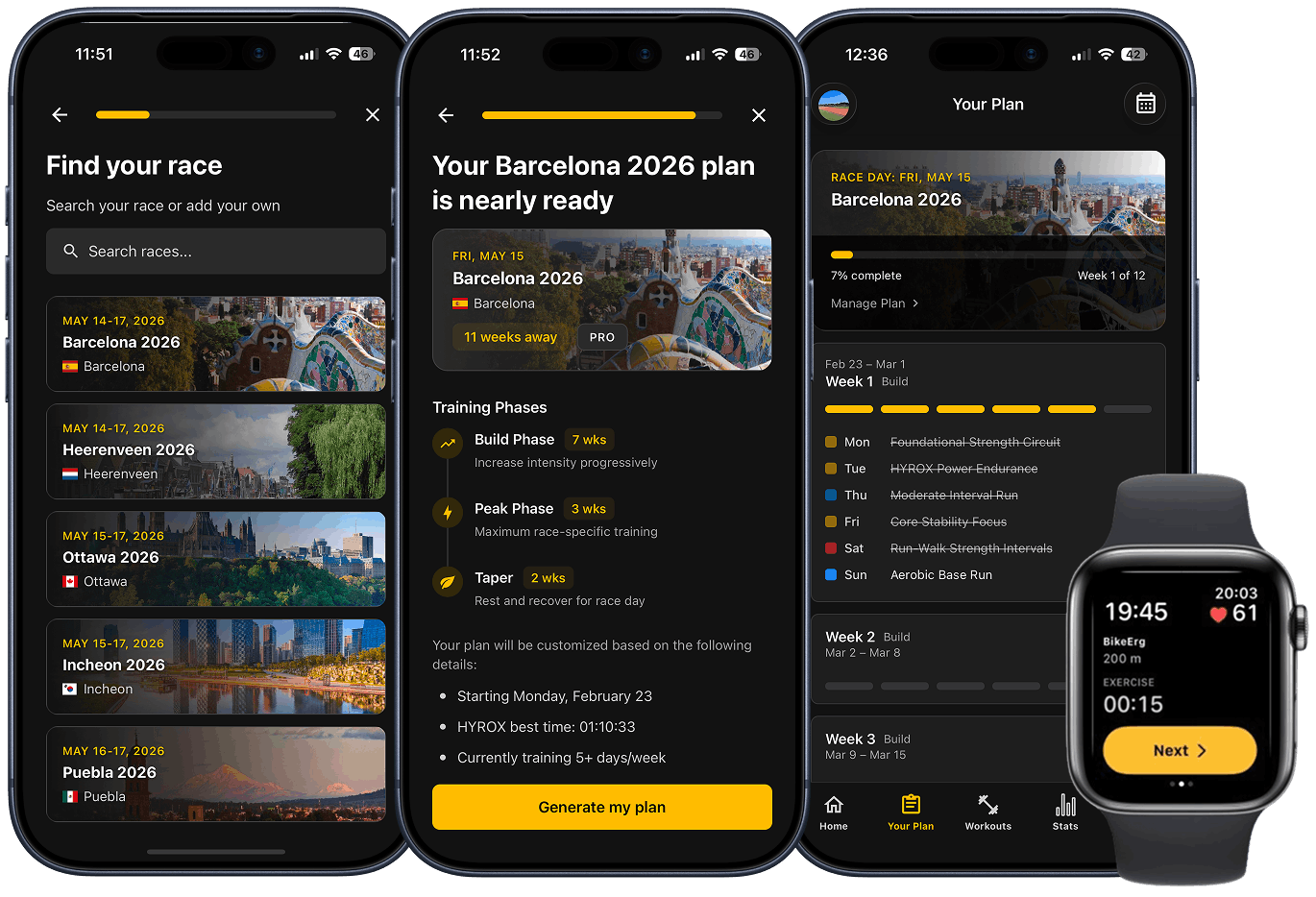
Ready for a structured plan?
Stop guessing what to do next. TrainRox builds personalized HYROX and hybrid fitness training plans based on your fitness level and race goals.
Get daily workouts, track your progress, and arrive at the start line knowing you've done the right work.


First week free. Cancel anytime.