
Using wearables to track training metrics
Testing
How to make the most of your smartwatch or wearable during HYROX prep.
Beyond Step Counting: Harnessing Your Wearable for HYROX Domination
The siren song of HYROX – a unique blend of functional fitness and endurance, demanding both brute strength and unwavering stamina – is growing louder. As you embark on this challenging journey, you're likely already strapping on your smartwatch, a ubiquitous tool in our tech-infused lives. But is it merely a glorified pedometer, or can it become your secret weapon in HYROX preparation? This article will demystify the potential of your wearable, transforming it from a passive observer into an active participant in optimizing your training for HYROX success.
For the intermediate athlete, already familiar with the demands of functional movements and endurance efforts, a deep dive into your wearable's capabilities can unlock a new level of performance. We'll move beyond basic step counts and heart rate monitoring to explore how specific metrics can inform your training decisions, leading to smarter, more effective preparation.
Understanding Your HYROX Training Metrics: The Data-Driven Approach
HYROX is a demanding test of your aerobic capacity, muscular endurance, and power. Your wearable, if utilized effectively, can provide invaluable insights into how you’re progressing in these key areas. Let's break down the crucial metrics and how to leverage them:
Heart Rate (HR) & Heart Rate Zones: This is your foundational metric. While your wearable likely displays your current HR, understanding heart rate zones is paramount for structured training. These zones are typically percentages of your maximum heart rate (MHR). Most wearables can estimate your MHR based on your age, but for greater accuracy, consider a maximal HR test (consult a professional for safety).
- Zone 1 (Recovery): 50-60% MHR. Essential for active recovery days.
- Zone 2 (Endurance): 60-70% MHR. The "fat-burning" zone, crucial for building your aerobic base and improving your ability to sustain effort over longer durations – directly applicable to HYROX's longer runs and sustained efforts.
- Zone 3 (Tempo): 70-80% MHR. Your "comfortably hard" zone. Excellent for building lactate threshold, which is vital for maintaining a strong pace during the race.
- Zone 4 (Threshold): 80-90% MHR. Pushing your limits. This zone trains your body to work at high intensities for shorter bursts, mirroring the demands of some of the HYROX stations.
- Zone 5 (Maximal): 90-100% MHR. Short, explosive efforts. While not the primary focus for sustained HYROX performance, understanding your peak capacity can be beneficial.
Actionable Advice: During your HYROX training, consciously monitor your HR during different types of workouts. For your long runs, aim to stay predominantly in Zone 2 and low Zone 3. For interval training designed to mimic the demands of the stations (e.g., sled pushes, lunges), push into Zone 4. Use your wearable's HR graph post-workout to analyze your effort distribution.
VO2 Max (Maximal Oxygen Uptake): This is the gold standard for measuring your aerobic fitness. Your wearable likely provides an estimated VO2 Max score. A higher VO2 Max indicates a greater capacity to deliver oxygen to your muscles, translating to better endurance and performance.
Actionable Advice: Track your VO2 Max over time. Consistent training, particularly in Zone 2 and 3, should see a gradual increase. If your VO2 Max plateaus or declines, it might signal overtraining or a need to adjust your training stimulus. Many wearables will prompt you to perform specific activities (like outdoor runs) to get a more accurate VO2 Max reading.
Training Load & Recovery: This is where your wearable truly shines in preventing burnout and optimizing progress. Many advanced wearables offer metrics like Training Load (an estimation of the physiological stress of your workouts) and Recovery Time (the recommended rest needed before your next intense session).
Actionable Advice: Pay close attention to your wearable's recovery recommendations. If your training load is consistently high and your recovery time is extended, it’s a clear indicator to scale back intensity or volume. Conversely, if you’re consistently below your optimal training load, you might be leaving gains on the table. Use this data to schedule rest days strategically and ensure you’re adequately recovered for key workouts.
Running Metrics (Pace, Cadence, Ground Contact Time): For the running portions of HYROX, these metrics are crucial for efficiency and injury prevention.
- Pace: Obviously, you need to monitor your running pace, but don't just focus on raw speed.
- Cadence: The number of steps you take per minute. A higher cadence (typically 170-180 steps per minute) can often lead to a more efficient stride and reduced impact on your joints – highly beneficial for the multiple running segments of HYROX.
- Ground Contact Time (GCT): The duration your foot spends on the ground during each stride. Shorter GCT generally indicates a more efficient and powerful stride.
Actionable Advice: Use your wearable to analyze your running form. If your cadence is consistently low, try incorporating drills to increase it. If your GCT is high, focus on explosive push-offs. Experiment with different running paces and analyze how these metrics change. This data can help you identify if your running form is efficient enough to handle the cumulative running volume of HYROX.
Strength and Power Metrics (Rep Counting, Power Output – if available): While not all wearables excel in precise strength tracking, some are improving. Features like rep counting can offer a general overview of your strength training volume. More advanced wearables might offer power output estimations during specific exercises.
Actionable Advice: Use rep counting with a grain of salt, as accuracy can vary. However, consistently tracking the number of reps and sets for key HYROX-specific exercises (e.g., lunges, kettlebell swings) can help you monitor progression in muscular endurance. If your wearable offers power output metrics for exercises like sled pushes or burpees, use this to track improvements in force production.
Integrating Wearable Data into Your HYROX Training Plan:
Simply collecting data isn't enough; you need to actively integrate it into your training.
- Define Your HYROX Goals: Before you even look at your wearable, understand what you need to improve. Is it your running endurance, your strength endurance for the sled push, or your ability to transition between exercises?
- Segment Your Workouts: When training, categorize your workouts. Are you doing a long, steady-state run (Zone 2 focus)? Are you doing high-intensity intervals mimicking the stations (Zone 4 focus)? Are you focusing on recovery (Zone 1)?
- Post-Workout Analysis: Dedicate time after each workout to review your wearable’s data. Look at your HR zones, pace variations, and any other relevant metrics. How did your actual effort align with your intended effort?
- Identify Trends: Don't just look at individual workouts. Review your data over weeks and months to identify trends. Is your VO2 Max improving? Is your recovery time getting shorter? Are you consistently hitting your target HR zones?
- Adjust Your Training: This is the most critical step. If your data shows you're consistently exceeding your recovery capacity, it's time to ease up. If your performance is plateauing, it might be time to increase intensity or volume. If your running cadence is consistently low, incorporate drills to improve it.
- Listen to Your Body, Augment with Data: Your wearable is a powerful tool, but it's not a replacement for listening to your body. If you feel unusually fatigued, even if your wearable suggests you're recovered, err on the side of caution. Your wearable provides objective data, but your subjective feeling is equally important.
- Experiment and Learn: Different workouts will provide different data. Experiment with various training modalities and analyze how your wearable responds. This iterative process will help you understand what works best for your body and your HYROX preparation.
- Sync with Other Platforms: Many wearables can sync with training apps like TrainingPeaks, Strava, or even specialized HYROX training platforms. This allows for more comprehensive analysis and easier sharing with coaches, if applicable.
Common Pitfalls to Avoid:
- Data Overload: Don't get bogged down by every single metric. Focus on the ones that are most relevant to your HYROX goals.
- Chasing Numbers: While it’s good to improve metrics, don't sacrifice good form or listen to your body just to hit a specific number.
- Ignoring Recovery: Your wearable might show you’re ready to train, but if you feel rundown, rest. Overdoing it is the fastest way to hinder progress.
- Inaccurate Data: Ensure your wearable is fitted correctly and that the sensors are clean for the most accurate readings.
By actively engaging with the data your smartwatch or wearable provides, you can transform it from a passive accessory into a dynamic training partner. For the intermediate HYROX athlete, this data-driven approach is not just about tracking progress; it’s about intelligently optimizing every aspect of your preparation, ensuring you arrive at the starting line primed for success. Embrace the tech, understand the metrics, and let your wearable guide you towards your HYROX goals.
Related Articles
How to benchmark your HYROX readiness
Test workouts and metrics to know if you're race-ready.
VO2 max and HYROX: What’s the connection?
Why VO2 max matters in hybrid fitness, and how to improve it.
Race simulations and performance tracking
How to simulate a full HYROX race and use the data to train smarter.
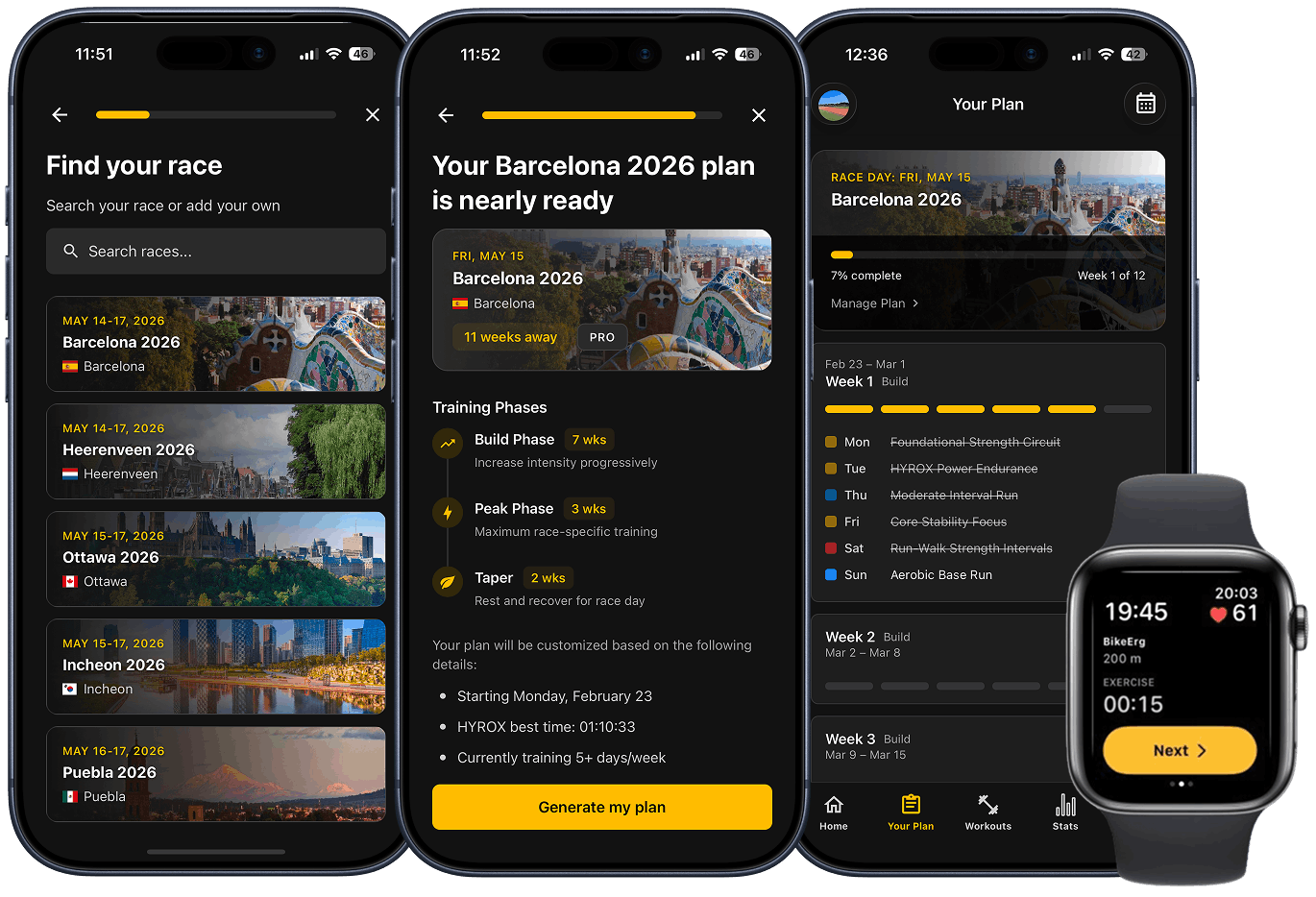
Ready for a structured plan?
Stop guessing what to do next. TrainRox builds personalized HYROX training plans based on your fitness level and race goals.
Get daily workouts, track your progress, and arrive at the start line knowing you've done the right work.

