
Race simulations and performance tracking
Testing
How to simulate a full HYROX race and use the data to train smarter.
Race Simulations and Performance Tracking: Your Strategic Blueprint for HYROX Domination
HYROX. The name itself conjures images of grit, endurance, and strategic execution. It’s a race that demands not only raw physical power but also intelligent pacing and precise transitions. For intermediate athletes aiming to conquer this demanding challenge, simply showing up and hoping for the best is a recipe for disappointment. The key to unlocking your full potential lies in race simulations and meticulous performance tracking. This article will equip you with the knowledge and actionable strategies to simulate a full HYROX race, dissect the resulting data, and train smarter to identify and conquer your weaknesses.
Why Simulate a HYROX Race? The Strategic Advantage
Think of a race simulation as your pre-competition rehearsal. It’s your opportunity to experience the race day environment without the pressure of an actual competition, allowing you to:
- Master Pacing: HYROX is a delicate balance. Go out too hard on the early functional movements and you’ll crumble on the later runs. A simulation lets you experiment with different pacing strategies, understand your body’s limits, and identify the optimal effort level for each segment.
- Refine Transitions: The seamless flow between exercises and runs is crucial. Practicing transitions in a simulated race environment helps you build muscle memory, minimize wasted energy, and improve your overall efficiency.
- Identify Weaknesses: This is perhaps the most critical benefit. During a simulation, you'll inevitably encounter moments where you struggle. These are not failures, but invaluable data points that highlight specific exercises or running segments where your conditioning is lagging.
- Build Mental Fortitude: Completing a full HYROX simulation is a significant psychological win. It builds confidence, familiarizes you with the mental fatigue, and prepares you for the demands of race day.
- Test Equipment and Nutrition: What shoes feel best for the entire distance? When should you take your hydration or fuel? A simulation is the perfect time to dial in these crucial race-day details.
Designing Your HYROX Race Simulation: A Practical Blueprint
The goal of your simulation is to mimic the race day experience as closely as possible. This means replicating the order of exercises, the distances of the runs, and importantly, the intensity and duration.
1. The Foundation: The HYROX Race Structure
Recall the standard HYROX format:
- 1km Run
- 8 Functional Workouts (each followed by a 1km run)
The functional workouts, in order, are:
- Ski Erg
- Sled Push
- Sled Pull
- Burpee Broad Jumps
- Rowing Erg
- Farmers Carry
- Sandbag Lunges
- Wall Balls
2. The Simulation Setup: Recreating the Environment
- Location: Find a space where you can execute all the exercises with minimal disruption. A gym with a treadmill, rower, ski erg, and adequate space for the other movements is ideal. If you don't have access to all equipment, get creative. A stationary bike can substitute for the rower or ski erg in a pinch, and if you don't have access to a sled, you can simulate the resistance with weighted objects or resistance bands.
- Timing: Block out a significant chunk of time. A full HYROX simulation will likely take you 1.5-3 hours, depending on your fitness level.
- Equipment: Ensure you have all the necessary equipment or functional substitutes.
- Nutrition and Hydration: Plan your pre-simulation meal and have your race-day hydration and fueling strategy in place.
3. Executing the Simulation: Pace, Effort, and Mindfulness
- Warm-up: A thorough warm-up is crucial to prepare your body for the sustained effort. Include dynamic stretching, light cardio, and specific movement prep for each exercise.
- The 1km Runs: Aim for a consistent, sustainable pace. Don't sprint. Think of it as a controlled effort that you can maintain throughout the entire race.
- The Functional Workouts:
- Effort Level: For your simulation, aim for an intensity that feels challenging but allows you to complete the repetitions with good form. You shouldn’t be completely spent after each exercise, but you should feel the effort. Think of a 7-8 out of 10 perceived exertion.
- Transitions: Focus on smooth, efficient transitions between the runs and exercises. Minimize rest beyond what’s necessary to set up for the next movement.
- Technique: Prioritize good form over speed. This is not the time to develop bad habits. Focus on executing each movement correctly.
- Rest: Keep rest periods between exercises to a minimum, mirroring race day. The only "rest" you get is the short transition time.
4. Data Collection: Your Performance Passport
This is where the magic happens. As you progress through your simulation, meticulously record key data points:
- Run Times: Time each 1km run.
- Exercise Durations/Rep Counts:
- Ski Erg, Rowing Erg: Record the time it takes to complete the 1000m distance.
- Sled Push, Sled Pull: Note the time taken to complete the distance.
- Burpee Broad Jumps: Record the time to complete the 100m.
- Farmers Carry: Record the time taken to complete the 200m.
- Sandbag Lunges: Record the time to complete the 100m (50m out and back).
- Wall Balls: Record the time to complete the 75 repetitions.
- Transition Times: While harder to be precise, make a mental note of how long it takes you to switch from one activity to the next.
- Perceived Exertion (RPE): After each run and exercise, jot down your RPE on a scale of 1-10. This subjective measure is incredibly valuable for understanding how hard you felt you were working.
- Heart Rate (Optional but Recommended): If you have a heart rate monitor, record your average and peak heart rate for each segment.
Analyzing Your Data: Unearthing the Truth
Once the simulation is complete, it’s time to dive into the numbers. This is where strategic training truly begins.
- Overall Time: This is your baseline. Compare it to your target race time and identify areas for improvement.
- Run Pace Consistency:
- Are your 1km run times relatively consistent? Or do they significantly degrade as the race progresses?
- Look for a pattern of increasing times. If your later runs are much slower, it points to a lack of aerobic endurance or pacing issues.
- Functional Workout Performance:
- Identify Bottlenecks: Which exercises took significantly longer than others? These are your direct weaknesses.
- Compare Exercise Durations: Are your sled push times much slower than your sled pull? Does the Sandbag Lunge feel disproportionately taxing?
- RPE vs. Time: If an exercise took a long time but your RPE was moderate, it might indicate a technique issue or a need for specific strength. If your RPE was high and your time was slow, it's a clear indicator of a conditioning deficit.
- Transition Efficiency: While difficult to quantify precisely without advanced tech, review your mental notes. Were there significant delays? Did you feel rushed or disorganized?
- Heart Rate Data (if applicable):
- Are your heart rates too high during the runs? This suggests insufficient aerobic conditioning.
- Are your heart rates recovering effectively between exercises? If not, your work-to-rest ratio might be off, or your overall fitness is lacking.
Actionable Advice: Training Smarter Based on Your Data
Now, translate your analysis into a targeted training plan.
If your runs are consistently slowing down:
- Increase Aerobic Volume: Incorporate more steady-state cardio sessions outside of your HYROX training. Focus on building your aerobic base.
- Tempo Runs: Introduce runs at a challenging but sustainable pace (e.g., 10-15% slower than your 5k race pace) to improve your lactate threshold.
- HYROX Simulation Runs: Make your simulation runs more race-pace oriented, focusing on maintaining a consistent effort across all segments.
If specific functional workouts are your weakness:
- Targeted Strength & Conditioning: If the Sled Push is slow, incorporate more explosive leg power exercises like squats, lunges, and plyometrics. For the Sled Pull, focus on posterior chain strength with deadlifts, glute bridges, and kettlebell swings.
- Specific Skill Practice: Dedicate training sessions to drilling the problematic movements. Practice sled pushes with varying weights and distances. Work on your Sandbag Lunge form and endurance.
- Hybrid Workouts: Combine the problematic exercise with short running intervals to simulate the race-day fatigue. For example, after a set of Sandbag Lunges, immediately run 200m.
If transitions are a problem:
- Practice Transitions: Actively practice transitioning between exercises in your training sessions, even outside of full simulations.
- Organize Your Gear: Think about how you’ll approach each station. Have your water bottle readily accessible, your towel in a consistent spot, etc.
If your RPE is consistently too high for a given pace/effort:
- Focus on Efficiency: Analyze your form during those specific movements. Is there wasted energy? Could you optimize your technique? Consider working with a coach.
- Build General Strength and Conditioning: Often, high RPE in multiple areas indicates a need for broader physical development.
Example Scenario: The Simulation Reveals a Sled Push Weakness
Let’s say your simulation data shows your 1km run times are relatively consistent, but your Sled Push times are significantly higher than your Sled Pull times, and your RPE during the push was an 8.5.
Analysis: This indicates a specific weakness in leg power and endurance for pushing.
Actionable Training Plan:
- Weekly Focus: Dedicate one session per week to Sled Push specific training.
- Drills:
- Heavy Sled Pushes: 3-4 sets of 20-30 meters with a challenging weight, aiming for good form. Minimal rest between sets (90-120 seconds).
- Shorter, Faster Sled Pushes: 6-8 sets of 10-15 meters with a slightly lighter weight, focusing on explosive leg drive.
- Sled Push Intervals: After a 200m run, immediately perform a 30-meter sled push. Repeat 3-5 times.
- Complementary Strength Work: Incorporate front squats, leg presses, and box jumps into your strength training.
- Maintain Other Areas: Continue with your regular running and other functional workout training to maintain overall fitness.
Conclusion: The Power of Data-Driven Preparation
Race simulations and performance tracking are not just optional add-ons for the dedicated HYROX athlete; they are fundamental pillars of a successful strategy. By investing the time and effort to simulate, analyze, and adapt, you transform guesswork into intelligent training. You move from simply completing HYROX to mastering it. So, embrace the process, crunch the numbers, and use the data as your strategic blueprint to crush your next HYROX race.
Related Articles
How to benchmark your HYROX readiness
Test workouts and metrics to know if you're race-ready.
Breaking 1:00: Can you finish a HYROX in under an hour?
What it takes to go sub-60 in a HYROX Open or Pro race, and how to work toward it.
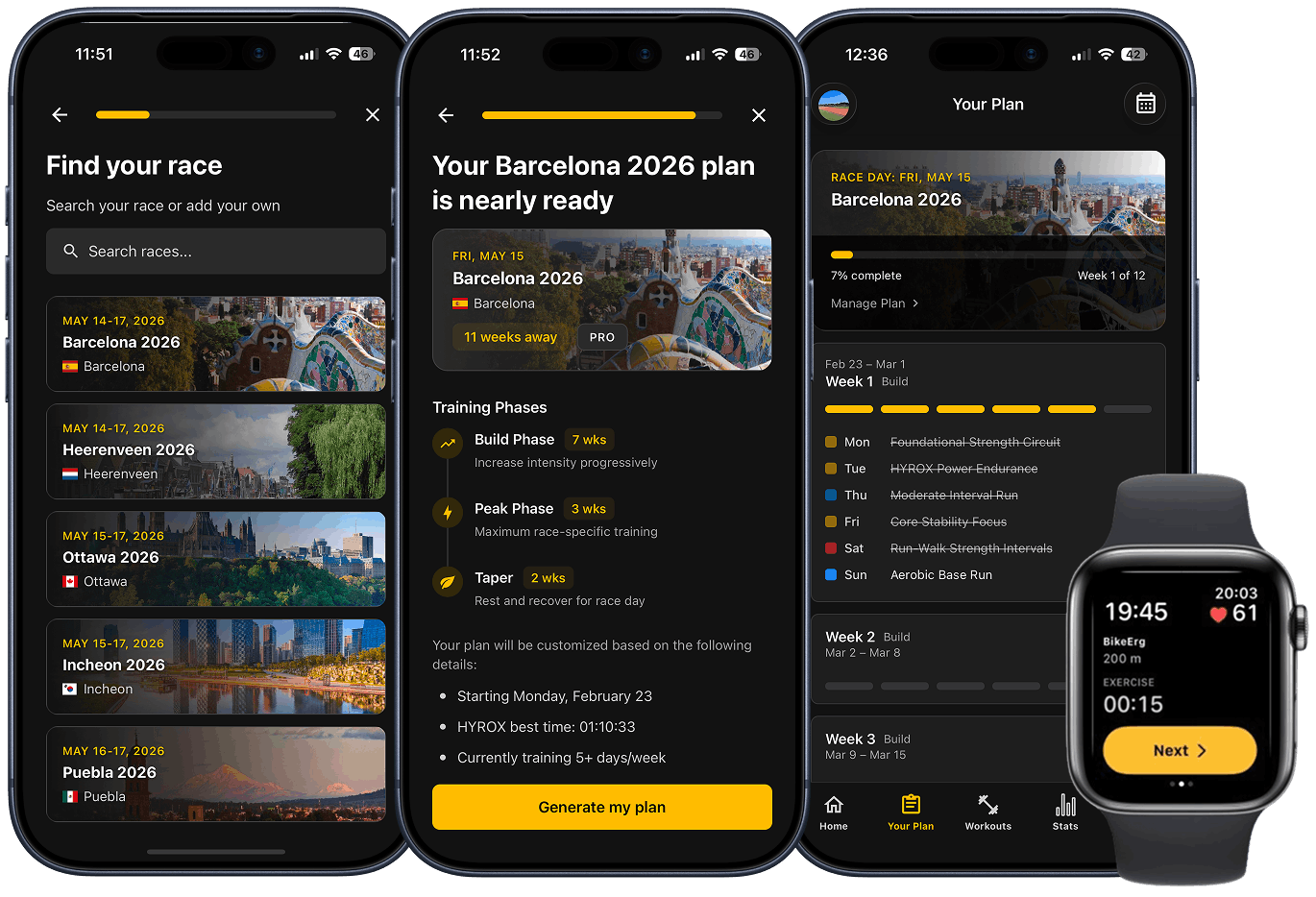
Ready for a structured plan?
Stop guessing what to do next. TrainRox builds personalized HYROX training plans based on your fitness level and race goals.
Get daily workouts, track your progress, and arrive at the start line knowing you've done the right work.

