

How to benchmark your HYROX readiness
Test workouts and metrics to know if you're race-ready.
Beyond the Hype: How to Benchmark Your HYROX Readiness
HYROX. The name itself conjures images of grit, determination, and the relentless pursuit of a formidable fitness challenge. It’s a race that demands a unique blend of strength, endurance, and mental fortitude, testing every facet of your athletic capability. But as the race day approaches, a crucial question looms large for every intermediate athlete: Am I truly ready?
Simply putting in the hours isn't enough. To conquer HYROX, you need to move beyond guessing and embrace a data-driven approach to your preparation. Benchmarking your readiness is the key to identifying your strengths, pinpointing your weaknesses, and ensuring you’re not just participating, but thriving on race day. This isn’t about predicting the future with certainty, but about building a tangible understanding of your current capabilities and setting yourself on a path to peak performance.
This article will guide you through the essential benchmarks for HYROX readiness, equipping you with the knowledge and actionable advice to measure your progress, set realistic goals, and approach the start line with confidence.
The HYROX Blueprint: Understanding the Demands
Before we dive into specific benchmarks, let's dissect what HYROX truly requires. Each race consists of 8 kilometers of running interspersed with 8 functional fitness exercises. The key here is the transition – the ability to quickly switch from a sustained aerobic effort to a maximal strength or muscular endurance effort, and then back again. This demands a well-rounded athlete, not a specialist.
Your benchmarks should reflect this duality. We need to assess your ability to:
- Sustain aerobic pace: How well can you run for extended periods?
- Execute strength movements with power and efficiency: Can you lift and move weights effectively under fatigue?
- Maintain muscular endurance: Can you perform repetitive movements without significant degradation?
- Transition seamlessly: How quickly and effectively can you move between the running and the workout stations?
- Manage fatigue: How does your performance degrade as the race progresses?
Benchmarking Your Run: The Foundation of HYROX
The running component of HYROX is not just about covering distance; it's about maintaining a consistent pace that allows you to recover sufficiently for the subsequent workouts.
The Benchmark: A Timed 8km Run
- The Test: Find a flat, measured 8km course. Treat this as a race simulation. Run at a pace you believe you can sustain for the entire HYROX race, focusing on consistent effort.
- What to Measure:
- Total Time: This is your primary metric. Compare it to your target race time.
- Pace per Kilometer: Monitor your pace throughout the run. Significant drops in pace can indicate early fatigue.
- Heart Rate Zones: Track your average and maximum heart rate. Aim to spend a significant portion of the run in Zone 2-3, with spikes into Zone 4 during harder intervals.
- What it Tells You: Your raw running engine. A faster time suggests better aerobic capacity. Consistency in pace indicates good pacing strategy and sustainable effort.
- Actionable Advice:
- Set a Target Pace: Based on your training history and the benchmark run, set a realistic average pace you aim to maintain for each kilometer of the HYROX race.
- Incorporate Interval Training: Blend steady-state runs with interval sessions (e.g., 400m repeats at a faster pace with recovery jogs) to improve your speed and VO2 max.
- Practice Running on Race-Specific Terrain: If your HYROX race involves varied terrain, try to incorporate some of that into your training runs.
Benchmarking the Workouts: Strength and Muscular Endurance Under Duress
This is where HYROX truly distinguishes itself. You're not just lifting weights; you're lifting weights after you've already run. Your benchmarks need to reflect this fatigued state.
The Benchmarks: Simulated Workout Stations
The most effective way to benchmark your workout readiness is to perform them in a fatigued state, mimicking race conditions.
1. Ski Erg:
- The Test: Complete 1000m on the Ski Erg as quickly as possible.
- What to Measure:
- Total Time: Your primary metric.
- Split Times (every 250m): Look for consistency or significant drops.
- What it Tells You: Your upper body and core endurance, as well as your ability to generate power after running.
- Actionable Advice:
- Practice with Running Intervals: Before your Ski Erg benchmark, perform a 1km or 2km run. Then, immediately attack the Ski Erg.
- Focus on Technique: Maintain a strong core, drive with your legs, and engage your lats.
2. Sled Push:
- The Test: Push a weighted sled for 50m. The weight will vary based on the HYROX division. Aim for a challenging but manageable weight that allows you to complete the distance with controlled, explosive strides.
- What to Measure:
- Total Time: How quickly can you cover the 50m?
- Number of Stride Cycles: Can you maintain efficient strides throughout?
- What it Tells You: Your lower body power and ability to generate force while maintaining balance.
- Actionable Advice:
- Practice with Shorter, Explosive Bursts: Mimic the push with powerful, short strides.
- Core Strength is Crucial: Engage your core to maintain stability.
3. Sled Pull:
- The Test: Pull a weighted sled for 50m. Again, the weight will vary. Focus on a smooth, consistent pull.
- What to Measure:
- Total Time: How quickly can you cover the 50m?
- Maintain an Upright Posture: Are you able to keep your back straight and avoid rounding?
- What it Tells You: Your posterior chain strength and ability to generate pulling power.
- Actionable Advice:
- Develop Grip Strength: This is crucial for a successful pull.
- Focus on Hip Hinge: Engage your glutes and hamstrings to pull.
4. Burpee Broad Jumps:
- The Test: Perform 100m of burpee broad jumps. This is a demanding full-body exercise.
- What to Measure:
- Total Time: How long does it take to complete the 100m?
- Form Breakdown: Are you able to maintain consistent form, or does your jump distance shorten?
- What it Tells You: Your explosive power, muscular endurance in the legs and shoulders, and your ability to recover between jumps.
- Actionable Advice:
- Practice in Sets: Instead of trying to do it all at once, break it down into smaller sets (e.g., 10m at a time with short rests).
- Focus on a Powerful Jump: Aim for distance on each broad jump.
5. Rowing:
- The Test: Row 1000m on the Concept2 Rower.
- What to Measure:
- Total Time: Your primary metric.
- Split Time (every 250m): Monitor your pace and look for consistency.
- Stroke Rate: Aim for an efficient stroke rate that allows you to maintain power.
- What it Tells You: Your cardiovascular endurance and full-body power generation, particularly in your legs and back.
- Actionable Advice:
- Practice with Running Intervals: Just like the Ski Erg, precede your rowing benchmark with a run.
- Master the Catch, Drive, Finish, and Recovery: Efficient technique is paramount.
6. Farmers Carry:
- The Test: Carry two kettlebells or dumbbells for 200m. The weight will vary.
- What to Measure:
- Total Time: How quickly can you complete the distance?
- Grip Strength Endurance: Can you maintain a strong grip without dropping the weights?
- Posture: Are you able to maintain an upright posture throughout?
- What it Tells You: Your grip strength, forearm endurance, and core stability.
- Actionable Advice:
- Incorporate Grip Strength Training: Dead hangs, farmer's walks in training, and using fat grips can all help.
- Engage Your Lats: Think about pulling your shoulder blades down and back to stabilize your torso.
7. Sandbag Lunges:
- The Test: Perform 100m of sandbag lunges. The weight will vary.
- What to Measure:
- Total Time: How long does it take to complete the 100m?
- Stride Length and Stability: Are your lunges deep and controlled, or are you wobbling?
- What it Tells You: Your single-leg strength, balance, and muscular endurance in your legs and glutes.
- Actionable Advice:
- Practice with Different Weights: Get comfortable with the feel of the sandbag.
- Focus on a Deep, Controlled Lunge: Ensure your back knee gently taps the ground.
8. Wall Balls:
- The Test: Perform 100 wall balls. The weight of the ball and the target height will vary.
- What to Measure:
- Total Time: How quickly can you complete the 100 repetitions?
- Rep Efficiency: Are you moving smoothly, or are you struggling to hit the target with each rep?
- What it Tells You: Your explosive lower body power, upper body strength, and cardiovascular endurance.
- Actionable Advice:
- Practice in Sets: Break it down into sets of 10-20 reps with short rests.
- Coordinate Your Movement: A smooth transition from the squat to the throw is key.
The Ultimate Benchmark: The HYROX Race Simulation
The most accurate way to benchmark your readiness is to simulate the entire HYROX race.
- The Test: Choose a day where you have adequate time and energy. Complete a 1km run, then perform the first workout station. Follow this with another 1km run, then the next workout station, and so on, for all 8km and 8 stations.
- What to Measure:
- Total Race Time: This is your most comprehensive benchmark.
- Time per 1km Run Segment: How did your running pace hold up throughout?
- Time per Workout Station: How quickly could you complete each station?
- Transition Times: How long did it take to move between the run and the workout?
- Perceived Exertion (RPE): How challenging did each segment feel on a scale of 1-10?
- What it Tells You: Your overall race-day pacing, your ability to manage fatigue across multiple disciplines, and your potential finishing time.
- Actionable Advice:
- Treat it Like the Real Deal: Use your race-day gear, fuel and hydrate appropriately beforehand.
- Identify Your "Rope Cutters": Which segments are significantly slower than others? This highlights areas needing more attention.
- Analyze Your Transitions: Can you make them smoother and faster?
Beyond the Numbers: Other Important Benchmarks
While quantitative data is crucial, don't underestimate these qualitative factors:
- Mental Fortitude: How do you respond to discomfort and fatigue? Are you able to push through challenges, or do you mentally check out?
- Nutrition and Hydration Strategy: How does your body respond to pre-race fueling and intra-race hydration?
- Recovery: How effectively do you recover between training sessions and workouts?
- Sleep Quality: Are you prioritizing sleep, which is essential for performance and recovery?
Setting Your Goals and Measuring Progress
Once you have your benchmark data, it's time to set smart goals:
- Specific: Target a specific time for your 8km run or a particular workout station.
- Measurable: Quantify your goals (e.g., shave 30 seconds off your Ski Erg time).
- Achievable: Set realistic goals based on your current fitness level and training capacity.
- Relevant: Ensure your goals align with your overall HYROX race-day objectives.
- Time-Bound: Set deadlines for achieving your goals.
Regularly re-benchmarking is key. Schedule these benchmark tests every 4-6 weeks during your training cycle. This allows you to track your progress, identify if your current training plan is effective, and make necessary adjustments. Celebrate your milestones and use setbacks as learning opportunities.
The Motivational Edge
Benchmarking is not about dwelling on perceived shortcomings; it's about empowering yourself with knowledge. Each benchmark test is an opportunity to:
- Visualize Success: See yourself hitting your target paces and completing workouts efficiently.
- Build Confidence: Every improvement, no matter how small, is a testament to your hard work.
- Stay Accountable: The data keeps you honest and focused on your training.
- Discover Your "Why": Remind yourself why you're taking on this challenge and what you're capable of.
By diligently benchmarking your HYROX readiness, you transform from a hopeful participant into a calculated competitor. You’ll approach the start line not with apprehension, but with the certainty that you’ve done the work, understood the demands, and are ready to unleash your potential. So, get testing, get measuring, and get ready to conquer HYROX!
Related Articles
Using wearables to track training metrics
How to make the most of your smartwatch or wearable during HYROX prep.
Race simulations and performance tracking
How to simulate a full HYROX race and use the data to train smarter.
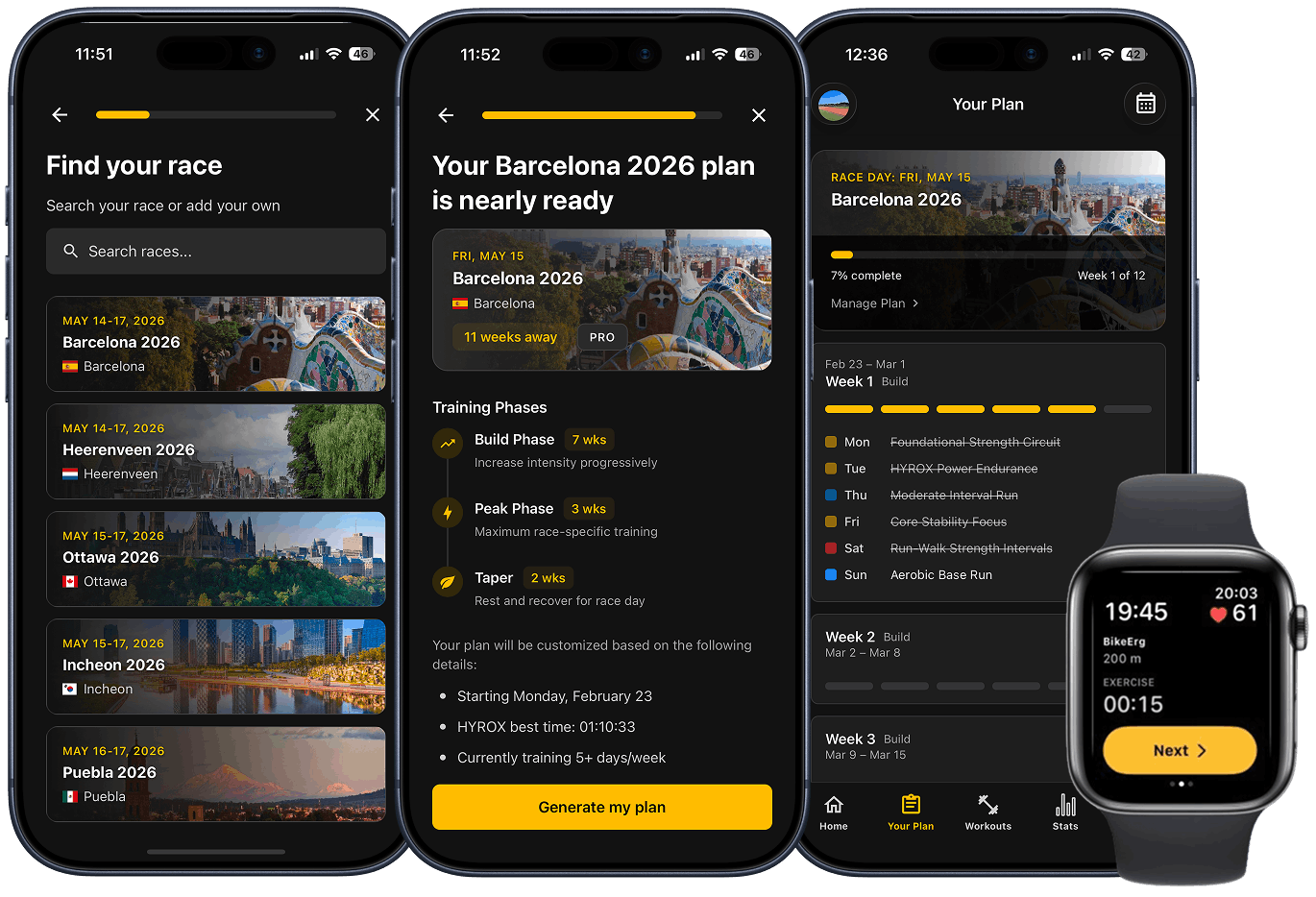
Ready for a structured plan?
Stop guessing what to do next. TrainRox builds personalized HYROX and hybrid fitness training plans based on your fitness level and race goals.
Get daily workouts, track your progress, and arrive at the start line knowing you've done the right work.


First week free. Cancel anytime.